How to read an ACORD 25 certificate of insurance, section by section
A section-by-section look at the standard ACORD 25 certificate of insurance, and a few things general contractors often check when one comes in.
Not advice. General information only, based on our research of publicly available sources, which can change. It is not legal, insurance, tax or accounting advice. Rules can vary by state, carrier and contract, so please talk to your insurance agent, attorney or tax professional about your situation.
In short: The ACORD 25 is the standard one-page certificate of liability insurance. The coverages table is usually the most important part: each row is a type of insurance with its own policy number, effective and expiration dates, and limits. Many GCs also check that the insured matches the business they're paying, that their company is the certificate holder, and that the issue date is recent. The form says it's for information only and doesn't change the policies.
Most certificates of insurance you'll get from subcontractors are on the same one-page form: the ACORD 25, Certificate of Liability Insurance. Once you know where things sit, reviewing one can take about a minute. If you'd like a copy in front of you, New York City publishes a sample ACORD 25.
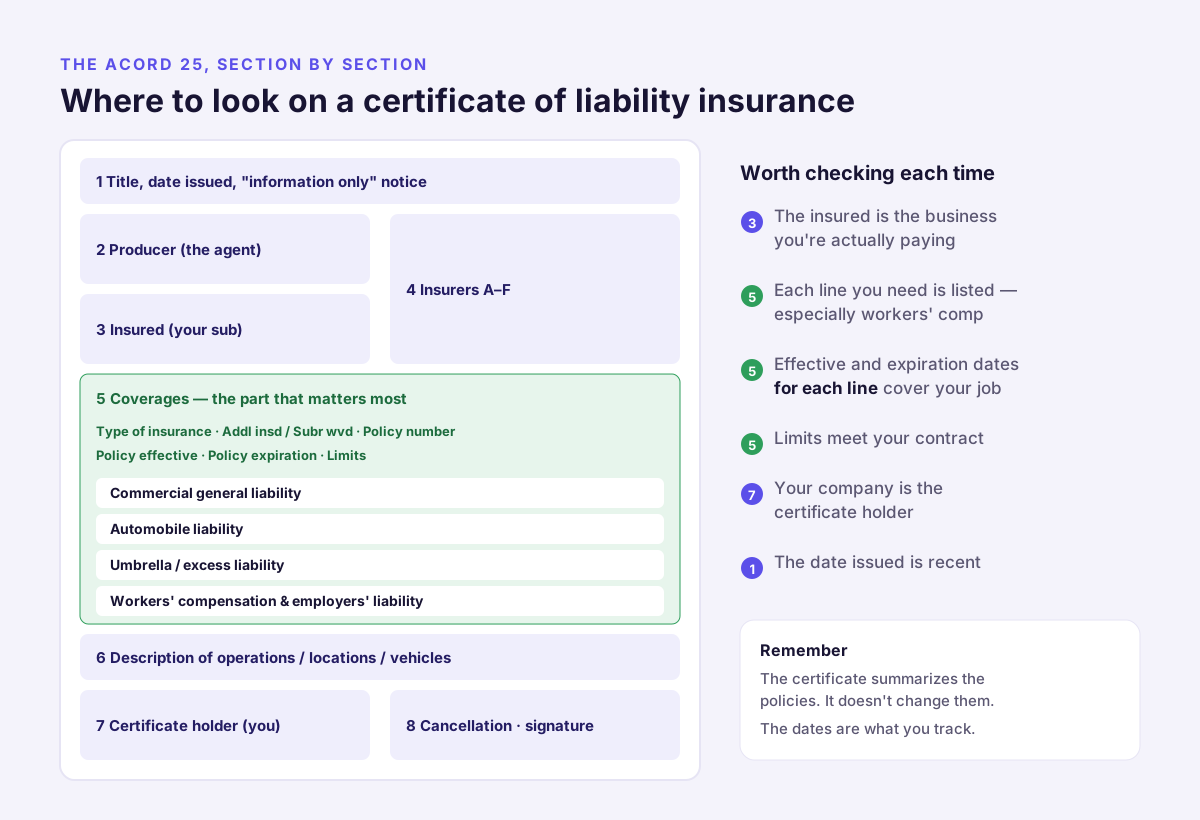
1. The top: title, date and the "information only" notice
At the top right is the date the certificate was issued. An older date isn't a problem in itself, but if a certificate was issued a year ago, the policies on it may have renewed since, so a fresh one might be worth requesting.
Across the top is a block of capital letters. In plain terms, it says the certificate is provided for information only, gives the holder no rights, and doesn't change the policies it describes. That may be the most useful thing to understand about a certificate: it's a summary of the sub's insurance, not the insurance itself.
2. Producer
The producer is the insurance agent or broker who issued the certificate, with their contact details. Many GCs save this, since the agent is often the quickest route to a renewal.
3. Insured
The insured is the sub's business: the name and address the policies are written to. It's worth checking that this matches the business you're actually paying. A certificate for "ABC Holdings LLC" may not speak for "ABC Framing Inc." unless that business is also listed.
4. Insurers A to F
Each insurance company on the certificate gets a letter (A, B, C…), and each coverage line below points to one. This tells you which company writes which policy, which can be useful if you ever need to ask about a specific one.
5. Coverages: usually the part that matters most
This table is where most of the detail lives. Each row is a type of insurance, and the columns generally show:
- INSR LTR: which insurer (A–F) writes it
- ADDL INSD / SUBR WVD: whether additional insured status or a waiver of subrogation is indicated for that line (more in our additional insured overview)
- Policy number
- Policy effective and expiration dates, for that line
- Limits: the dollar amounts
Common rows include:
| Row | What people often look at |
|---|---|
| Commercial general liability | Each occurrence and general aggregate limits; occurrence vs. claims-made |
| Automobile liability | Combined single limit; which vehicles are included |
| Umbrella / excess liability | Additional limits on top of the others |
| Workers' compensation & employers' liability | Whether it's listed, its dates, and the employers' liability limits |
Dates are easy to overlook. Each line has its own dates, and general liability and workers' comp often end on different days, so tracking each line separately may be more reliable than tracking "the certificate."
6. Description of operations / locations / vehicles
A free-text box agents may use for project names, job addresses, additional insured wording and other notes. It's worth reading, keeping in mind the "information only" notice: wording here describes the policies rather than creating coverage.
7. Certificate holder
That's usually you: the company the certificate was issued to.
8. Cancellation and signature
The bottom section covers notice if a policy is cancelled before it expires, and carries the authorized representative's signature. Relying on receiving a cancellation notice may not be enough on its own; many contractors track expiration dates themselves.
A quick review some GCs use
When a certificate comes in, you might check:
- The insured matches the business you're paying.
- Each coverage line you've asked for is listed, especially workers' comp (or there's an exemption document instead; see Florida workers' comp exemptions for one state's version).
- The dates on each line cover the work and the dates you expect to pay.
- The limits line up with your contract. Your agent can help with this.
- Your company is the certificate holder.
- The issue date is reasonably recent.
Filing it next to the sub's payments may also help, since at a workers' comp audit the two are often compared.
Frequently asked questions
What is an ACORD 25?
It's the standard Certificate of Liability Insurance form used across the US insurance industry to summarize a business's liability policies on one page.
What's the most important part of an ACORD 25?
For many GCs, it's the coverages table: which types of insurance are listed, the policy dates for each line, and the limits.
What does "ADDL INSD" mean on a certificate?
It's the additional insured column. A "Y" indicates the agent is showing additional insured status for that coverage line; that status itself comes from the policy, usually through an endorsement.
Does an ACORD 25 prove coverage?
The form states it's issued for information only and doesn't change the policies it describes. Questions about whether a policy is in force are for the agent or carrier.
Why does each coverage line have its own dates?
Each line is often a separate policy, and policies can start and end on different days, so general liability and workers' comp may expire at different times.
Letting software do the reading
CertiSub reads each certificate a sub uploads and drafts every coverage line, with its insurer, policy number, dates and limits, for you to confirm. Nothing is recorded until you do. After that, it tracks each line's expiration and sends renewal reminders ahead of time. More in our certificates of insurance guide.
This article is for general informational purposes only. It reflects our research of publicly available sources as of its publication date and may not be complete or current. It is not legal, insurance, tax or accounting advice, and reading it does not create any professional relationship. Requirements can vary by state, insurance carrier, policy and contract. Before making decisions, consult a licensed insurance professional, an attorney, or a tax professional about your specific situation. CertiSub is a recordkeeping and document-organization tool. It tracks the documents and dates you provide. It does not verify insurance validity or provide legal, insurance, or compliance advice.