Workers' comp audit: what happens and how to prepare
What may happen at a workers comp audit — why it happens, the types of audits, what auditors often ask a general contractor for, how subcontractors can affect the result, and ways to prepare.
Not advice. General information only, based on our research of publicly available sources, which can change. It is not legal, insurance, tax or accounting advice. Rules can vary by state, carrier and contract, so please talk to your insurance agent, attorney or tax professional about your situation.
In short: A workers' comp audit is a review, usually after your policy period ends, that compares the payroll your premium was estimated on with your actual records. It may lead to a refund, an additional bill, or no change. Auditors often ask for payroll and tax records, a list of what you paid subcontractors, and their certificates of insurance. Payments to subs without evidence of their own coverage may be added to your payroll, depending on your carrier and state.
If you run a construction company, there's a good chance a letter shows up at some point: your workers' compensation carrier wants to audit your policy. For many general contractors it can be one of the more stressful bits of paperwork in the year, not because anything is wrong, but because the records involved are often scattered across inboxes, truck cabs and filing cabinets.
Here's an overview of what a workers' comp audit generally is, what you might be asked for, how subcontractors can come into it, and ways contractors keep their records ready.
What is a workers' comp audit?
Progressive's guide to workers' comp audits describes it as "a routine evaluation of your workers' compensation policy, payroll records, and employee classifications."
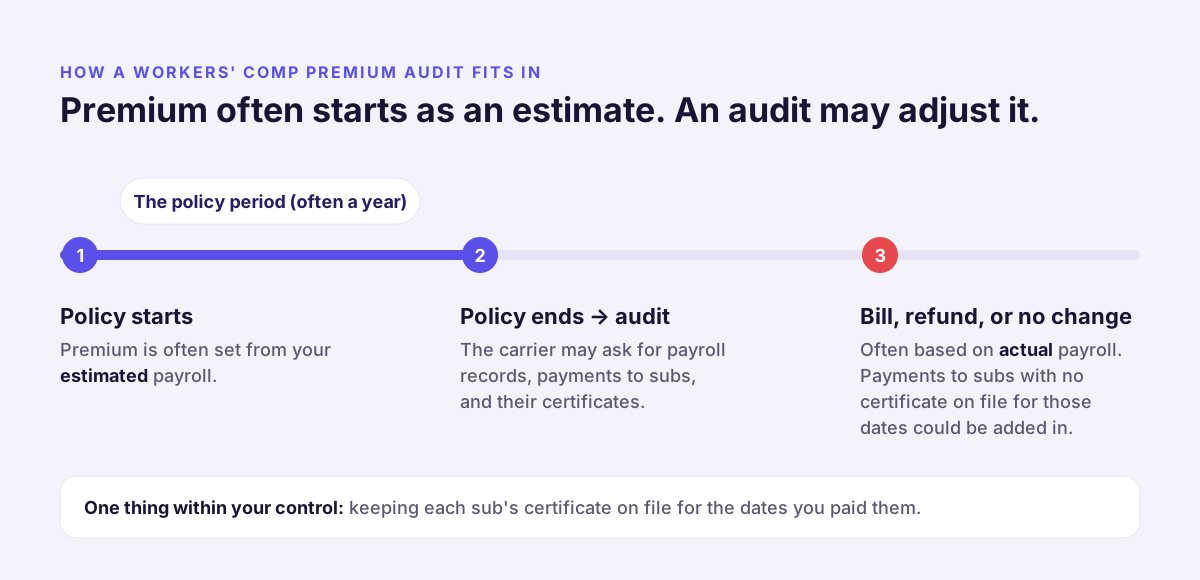
The reason it exists is that premium is often set at the start of a policy from an estimate. As Nationwide puts it in its premium audit guide, "the premium you pay is based on an estimate of your exposures, such as payroll or gross sales." Actual payroll usually isn't known until the policy period is over, so the carrier may check the real numbers and adjust. The Hartford's workers' comp audit page describes it this way: your policy "requires audits to verify your estimated payroll."
What can happen after the audit?
Depending on how your actual numbers compare with the estimate, the result could be a refund, an additional bill, or no change. Progressive puts it simply: "If the insurance review shows you overpaid or underpaid last year, you could get a refund or need to pay the difference."
What types of workers' comp audits are there?
Carriers use a few formats, and which one you get may depend on your carrier, your state and the size of your business. Nationwide's guide describes:
- Physical audits. "A premium auditor will visit your business to review the information needed to complete your audit." The Hartford calls these field audits: "Field audits are physical audits on-site at your place of business."
- Telephone audits. "A premium auditor will contact you by telephone to gather the information needed to complete your audit."
- Online audits, where the carrier sends audit forms for you to complete and return with copies of your records.
What does a workers' comp auditor ask for?
Your carrier's list is the one that counts, and it may differ. As examples, The Hartford's audit page mentions an accounting ledger, tax forms such as W-2, 1099, Form 941, Form 944 and a federal tax return, a certificate of insurance for every subcontractor, and descriptions of each business function. Progressive's guide lists similar documents, plus information about owners, partners and officers.
In practice, requests often include some version of:
- Payroll records for your own employees for the policy period. The Hartford notes: "When reporting your payroll, be sure to include any overtime payments employees receive."
- A list of people you paid who weren't on payroll, often subcontractors, with amounts. This might come from a general ledger, check register or 1099s.
- Certificates of insurance for those subcontractors, showing their own workers' comp coverage.
- Exemption documents for subs who don't carry workers' comp, where a state allows exemptions. (For one state's version, see our Florida workers' comp exemption guide.)
- Information about owners and officers, such as names, titles and ownership.
- A description of what your business does, which can affect how payroll is classified.
Why job classifications matter
Workers' comp rates generally depend on the kind of work being done, so payroll is grouped into classifications. If an audit finds that the work your people actually did differs from what the policy assumed, the classification, and therefore the premium, could change. If you're unsure how your payroll should be classified, your agent is the right person to ask before the audit.
How subcontractors can affect your audit
This is the part that tends to surprise people. Nationwide's guide says: "If no evidence of insurance is available, the subcontractor's payroll may be added to your premium base as payroll."
The detail that often trips people up is dates. A certificate generally speaks for the period its coverage dates cover, so a certificate that ended in June might not help with a payment made in July. We walk through this in workers' comp audits and subcontractors.
An illustration with numbers
This is a simplified, hypothetical example to show the idea. Real calculations depend on your carrier, your state and your classifications.
Say a GC paid a framing sub $60,000 over the policy year: $40,000 while a certificate showing the sub's workers' comp was on file, and $20,000 after that certificate's dates had passed, with no renewal on file. If the carrier treated the uncovered $20,000 as the GC's own payroll for that classification, the GC's premium would be recalculated with that amount added. At a hypothetical rate of $10 per $100 of payroll, that would be about $2,000 of additional premium. A current certificate on file for those dates might have kept that payment out of the calculation.
What happens if you don't respond to an audit?
It's generally worth responding promptly. Nationwide's guide says: "Complying with the audit is also important to avoid noncompliance charges." It also describes what may happen if records don't come in: "If your auditor isn't able to obtain the required documents from you, we'll mail a 10-day final warning letter." Other carriers may handle this differently, so the letter from your own carrier is the guide to follow.
What if you disagree with the audit result?
If the result doesn't look right, for example if payroll was put in the wrong classification, or payments to a sub with coverage were counted, many contractors start by contacting the carrier's audit department and their agent, with the documents that support their position. Some states also have formal processes for disputes. Your agent can explain the options for your carrier and state.
How to prepare for a workers' comp audit
Many contractors find it easier to gather records as they go rather than after a notice arrives. A few approaches that may help:
Collecting a certificate before the first payment
Some GCs treat "certificate on file" as a step before a new sub's first invoice is paid. It's often easier to get paperwork from someone waiting on a check than from someone paid months ago.
Keeping an eye on expiration dates
Policies typically renew, and not on your schedule. Tracking each sub's expiration dates and asking for renewals before they lapse may save a scramble later. Our COI tracking overview describes one simple way to do it.
Keeping payments and certificates together
At audit time, a common question is whether there was a certificate on file covering the date of each payment. Keeping payment records and certificates in the same place can make that much quicker to answer.
Holding on to records
Audits can arrive months after a policy ends, so it may be worth keeping certificates and payment records well after a job finishes. For W-9s, the IRS's guidance on independent contractors says they "should be kept in your files for four years."
A sample workers' comp audit checklist
Your carrier's list is the one that counts, but a starting point might be:
- Payroll reports and quarterly tax filings for the policy period, including overtime
- A list of subcontractors paid, with amounts and dates
- Certificates of insurance for each, covering the dates paid
- Exemption documents for any sub without workers' comp
- 1099s for your subcontractors
- Owner, partner and officer information
- A short description of your operations
Frequently asked questions
What is a workers' comp audit?
It's a review of your workers' compensation policy, payroll records and job classifications, often done after the policy period ends, that compares the payroll your premium was estimated on with your actual payroll.
When does a workers' comp audit happen?
Commonly after the policy period ends, since that's when actual payroll is known. Your carrier's notice will give the timing and format for your audit.
What do I need for a workers' comp audit?
Carriers' lists vary, but they often include payroll and tax records (such as W-2s, 1099s and Form 941), your accounting ledger, a list of subcontractors paid, their certificates of insurance, exemption documents, and information about owners and officers.
Can a workers' comp audit increase my premium?
It can. If actual payroll is higher than estimated, if work is classified differently, or if payments to subcontractors without evidence of their own coverage are added to your payroll, the result may be additional premium. It can also result in a refund or no change.
What happens if I ignore a workers' comp audit?
Carriers may apply noncompliance charges. Nationwide, for example, says it sends a 10-day final warning letter if it can't obtain the required documents. Your carrier's own notice is the guide to follow.
Do subcontractors count as payroll in a workers' comp audit?
They may, depending on your carrier and state. Nationwide's guide says that if no evidence of insurance is available, a subcontractor's payroll may be added to your premium base. A certificate showing the sub's own workers' comp for the dates you paid them is commonly what auditors look for.
The short version
- Workers' comp premium often starts on an estimate and may be adjusted by audit.
- Audits can be in person, by phone, or online.
- Auditors frequently look at what you paid subs alongside the certificates on file.
- A payment without a certificate behind it could be added to your payroll, depending on your carrier and state.
- Collecting certificates early, asking for renewals before they lapse, and keeping payments and certificates together may make an audit easier.
CertiSub is designed to help with that last part: subs can upload certificates from a link on their phone, renewal reminders go out automatically, and payments made outside the certificate dates on file are flagged on your dashboard, so you can look into them when it suits you.
This article is for general informational purposes only. It reflects our research of publicly available sources as of its publication date and may not be complete or current. It is not legal, insurance, tax or accounting advice, and reading it does not create any professional relationship. Requirements can vary by state, insurance carrier, policy and contract. Before making decisions, consult a licensed insurance professional, an attorney, or a tax professional about your specific situation. CertiSub is a recordkeeping and document-organization tool. It tracks the documents and dates you provide. It does not verify insurance validity or provide legal, insurance, or compliance advice.