Workers' comp audits and subcontractors: why payments without a certificate could be added to your bill
How a workers comp audit may treat subcontractors, why a payment made outside a sub's certificate dates could end up on your bill, and habits that may help.
Not advice. General information only, based on our research of publicly available sources, which can change. It is not legal, insurance, tax or accounting advice. Rules can vary by state, carrier and contract, so please talk to your insurance agent, attorney or tax professional about your situation.
In short: At a workers' comp audit, an auditor may look at each subcontractor you paid and whether you had evidence of their own workers' comp, usually a certificate of insurance, for the dates you paid them. Where there isn't any, those payments may be added to your payroll, depending on your carrier and state. Gaps often come from renewals that arrive late, so tracking each sub's expiration dates may help.
Talk to enough general contractors about workers' comp audits and you may hear a version of this story: "We'd used that sub for years. Their certificate had expired in the spring and nobody noticed. The auditor added what we paid them after that to our payroll."
It's a fairly common source of surprise on an audit bill. Here's a general look at how subcontractors can come up in a workers' comp audit, and why the dates on their certificates may matter as much as the certificates themselves.
Why carriers ask about your subs
A general contractor may be on the hook for an uninsured subcontractor's workers. Nationwide's premium audit guide puts it this way: "Most state Workers Compensation laws will hold you responsible for injuries sustained by an employee of an uninsured subcontractor."
That's one reason an auditor might go through who you paid and look for evidence of each sub's own coverage, which is usually the certificate of insurance on file. Where there isn't one, Nationwide says: "If no evidence of insurance is available, the subcontractor's payroll may be added to your premium base as payroll." The Hartford's audit checklist similarly lists a "certificate of insurance for every subcontractor."
How this plays out can vary a lot by state, carrier and the facts of each job. Your agent is the right person to explain how yours approaches it.
It's often about dates, not just paper
Many contractors do collect certificates. The catch is that each coverage line on a certificate has a start and an end date, and payments can keep happening after the end date.
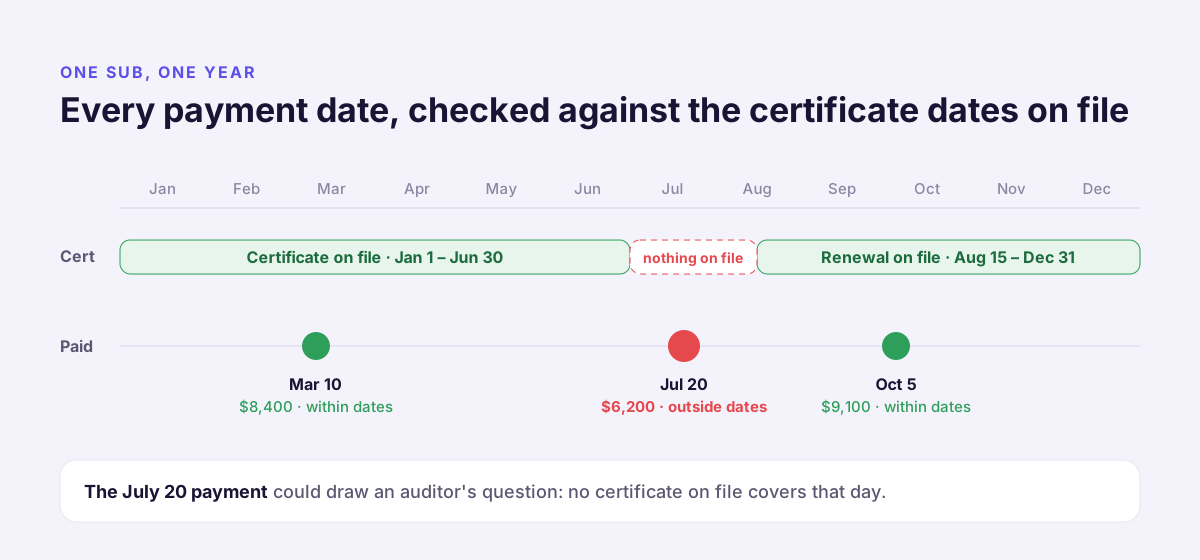
In this example, the sub sent a certificate in January and a renewal in August. Two of the three payments fall within the dates on file. The July 20 payment falls in the weeks between, when nothing on file covers that day, so it's the kind of payment an auditor could ask about.
That doesn't mean anyone did anything wrong. The sub may well have had coverage the whole time and simply sent the renewal late. An audit, though, tends to work from what's on file.
An illustration with numbers
A simplified, hypothetical example. Real outcomes depend on your carrier, state and classifications.
Using the chart above, suppose the three payments were $8,400 (March 10), $6,200 (July 20) and $9,100 (October 5). If the carrier counted only the July 20 payment as uncovered, $6,200 might be added to the GC's payroll for that classification, while the $17,500 paid within the certificate dates on file might not be. A renewal certificate on file before July 20 might have kept that payment out.
Where these gaps can come from
- Renewals that arrive late. The sub renews, but the new certificate doesn't get requested.
- Certificates collected once. A certificate is on file, so it looks done, until someone checks the dates.
- First payments before paperwork. An invoice gets paid before the certificate arrives.
- One line checked, not all of them. The certificate shows general liability, but the workers' comp line is missing or ends sooner. Knowing how to read a certificate of insurance line by line may help here.
Habits that may help
These are practices many GCs use. Your agent can tell you what makes sense for your business.
- Asking for a certificate before the first payment, and checking that it shows workers' comp (or that there's an exemption document instead).
- Tracking each sub's expiration dates and asking for renewals ahead of time. Around 30 days out is a common starting point. Our COI tracking overview covers one way to do this.
- Comparing payments with certificate dates as you go, rather than once a year. A payment outside the dates may be easier to sort out the same month than many months later.
- Keeping exemption documents on file for subs who don't carry workers' comp, and asking your agent whether the exemption applies.
If you find a payment outside the dates
One option is to ask the sub for a certificate showing the coverage they had on those dates. Their agent may be able to provide one. If it turns out there was no coverage for that period, it's probably worth a conversation with your own agent before an audit.
Frequently asked questions
Do subcontractors affect a workers' comp audit?
They can. Auditors may review what you paid each subcontractor and whether you had evidence of their own workers' comp coverage, commonly a certificate of insurance, for that period. Where there isn't any, payments may be added to your payroll, depending on your carrier and state.
What if a subcontractor's certificate expired during the job?
Payments made after the expiration date may not have a certificate behind them. One option is to ask the sub's agent for a certificate showing the coverage they had on those dates, and to talk with your own agent before the audit if there was none.
Does a workers' comp exemption count instead of a certificate?
Some states allow certain owners to file an exemption, and many GCs keep that document on file. How a carrier treats it can depend on who did the work and the carrier's approach, so your agent is the person to ask.
How can I avoid surprises with subcontractors at audit time?
Many GCs collect a certificate before the first payment, track each coverage line's expiration date, ask for renewals ahead of time, and keep payments and certificates together so they can be compared as they go.
How CertiSub is designed to help
CertiSub keeps each sub's certificates and your payments in one place and compares the dates for you. Each payment shows whether it falls inside or outside the certificate dates on file, and the dashboard totals any dollars paid outside those dates, so a payment like the July 20 one could be spotted when it's logged rather than months later. Renewal reminders go to the sub and their agent at 30, 14 and 3 days before a certificate expires.
This article is for general informational purposes only. It reflects our research of publicly available sources as of its publication date and may not be complete or current. It is not legal, insurance, tax or accounting advice, and reading it does not create any professional relationship. Requirements can vary by state, insurance carrier, policy and contract. Before making decisions, consult a licensed insurance professional, an attorney, or a tax professional about your specific situation. CertiSub is a recordkeeping and document-organization tool. It tracks the documents and dates you provide. It does not verify insurance validity or provide legal, insurance, or compliance advice.